Matthew Bayly, MSc., R.P. Bio.
About Me:
I am dedicated to a career that seeks to bridge the realms of aquatic science, fisheries, quantitative modelling, AI-enabled software, and web systems. My primary focus involves aiding organizations in river restoration and watershed management through the provision of dynamic web-based tools and support for intricate analyses, grounded in physical and ecological models. Leveraging my extensive background in aquatic sciences, I excel at integrating diverse components from hydrology, engineering, population ecology, GIS, and statistics.

My work is driven by the recognition that aquatic ecosystems pose formidable challenges to manage and conserve due to their inherent complexity and interconnectivity. However, I firmly believe that within these challenges lie opportunities. By synthesizing innovative tools, robust frameworks, and models, I am dedicated to advancing our understanding of risk and uncertainty in the face of actions and inactions. Ultimately, my goal is to contribute to effective management and conservation of aquatic ecosystems, benefiting not only the myriad species that rely on them, such as salmon, but also the communities and individuals whose lives are intricately tied to them.
My role entails collaborating with committees and working groups to enhance their efficiency in tackling complex technical challenges related to water management, restoration efforts, monitoring initiatives, and data management. To facilitate these endeavors, I engage in the co-development of transparent tools. These tools are designed to aid in planning and decision-making processes. Their overarching objective is to clarify areas of uncertainty and reduce ambiguity, thereby creating a structured framework for managing risks. Rather than attempting to eliminate risk and uncertainty entirely, my approach is to provide a framework that helps contextualize key components. For instance, this may involve integrating models that quantify factors like instream flow, stream temperature, or fish habitat with other tools that establish connections to upstream stressors or development activities. Subsequently, I strive to estimate the productivity or identify limiting factors for specific species, transitions, or life stages of interest. The aim of this work is to foster a shared understanding of restoration project opportunities. Emphasis is placed on assessing their relative benefits in terms of both direction and magnitude, all within the broader context of existing threats.
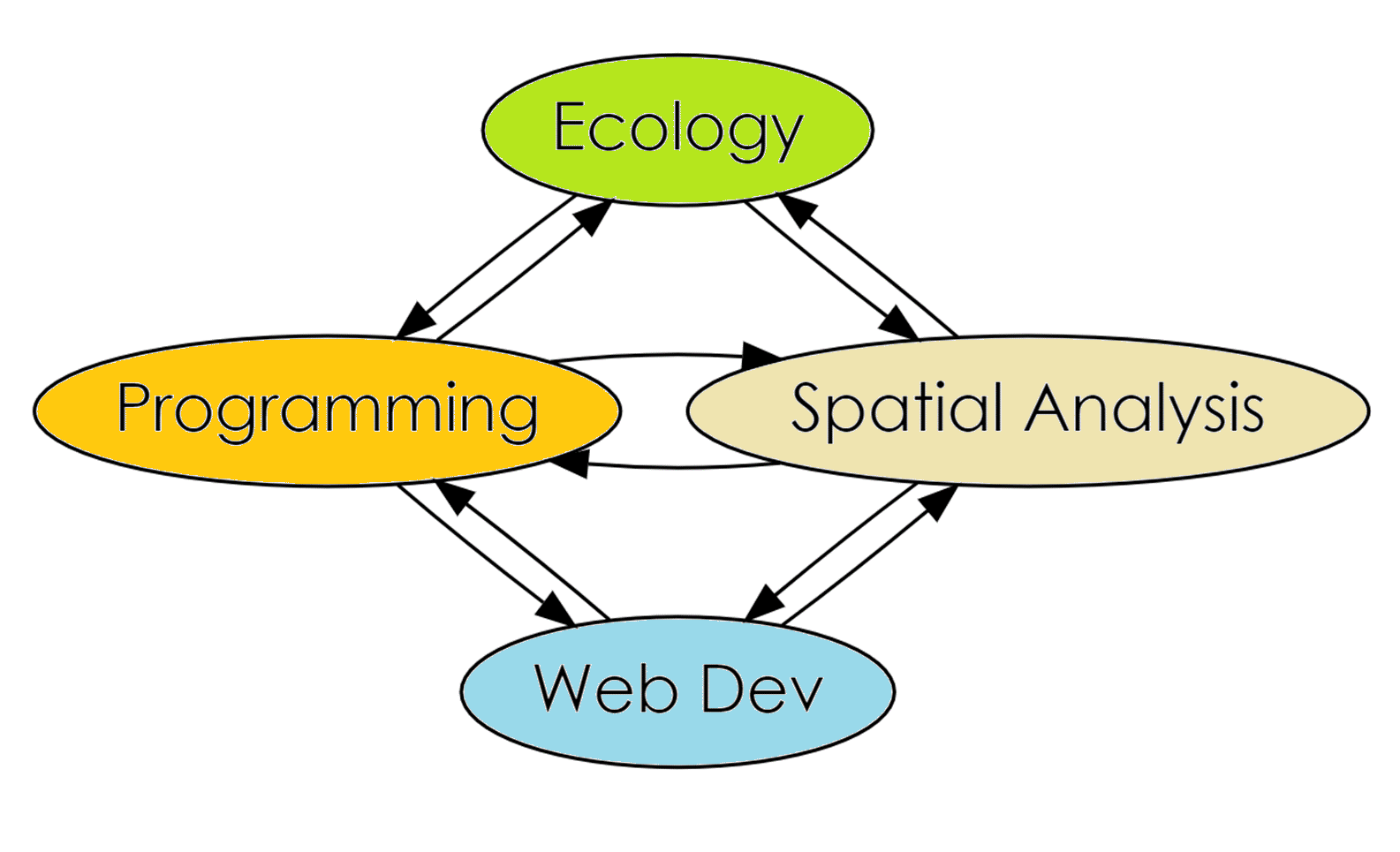
I am very passionate about software architecture and tool development – especially if it involves spatial data. Until recently, I worked primarily within R, Python, JavaScript, and PHP, but I now use AI-assisted software development to make highly customized environmental decision-support tools faster, more affordably, and with more iteration directly with users, while maintaining technical judgment, transparency, and domain-specific quality control. Recent advances in AI-assisted software development have significantly expanded what is practical to build for individual projects, working groups, and decision-support processes. I use AI coding agents as force multipliers within a disciplined development workflow, allowing me to prototype, refine, and deploy customized tools more quickly while keeping the scientific logic, data structures, and user requirements grounded in domain expertise.
Some of my previous project applications include linear network modelling to generate basin-level predictions across large geographic areas. For example, in British Columbia I have been able to apply basin-level regression equations to over 5 million streamline reaches within a network model quantifying upstream accumulation. I also participate in field work (where possible) to gather topographic data with RPAS (drones), LiDAR or hydrology research programs. I then use these resources to build hydrodynamic models that can simulate and estimate fish habitat under different flow regimes. Within freshwater fisheries, I often leverage preexisting data from conventional monitoring programs and then build models to estimate smolt-production potential, intrinsic population-level trends (with integrated population models) and other components of habitat, fish densities, and/or productivity. My analytical expertise and experience with these systems is grounded in years of hands-on technical field work across British Columbia, Northwest Territories, and parts of California and Oregon.
The projects and applications described in this bio are often completed within a team environment. I work hard to maintain a network of collaborators, colleagues, and working relationships with associates and other professionals in related disciplines.
I am always eager to jump on the phone to discuss related projects, alternative approaches, and scoping exercises. If I can’t provide support, I am almost always able to connect you with other specialists. Please don’t hesitate to reach out for a chat.
Matthew Bayly, M.Sc., R.P. Bio.
M.J. Bayly Analytics Ltd.
info@mjbayly.com
Whistler BC
Matthew Bayly - CV
Quantitative Biologist | Principal M.J. Bayly Analytics Ltd.
Education
- Master of Science, Botany | University of British Columbia | 2013-2015
- Bachelor of Science, Biology | University of Victoria | 2007-2011
- Register Professional Biologists with the British Columbia College of Applied Biologists.
Selected Reports and Publications
- Bayly, M., Tekatch, A., and Rosenfeld, J. 2026. Application of a Cumulative Effects Model for Prioritizing Recovery Actions in Nooksack Dace and Salish Sucker Critical Reaches. Report prepared by ESSA Technologies Ltd. for the University of British Columbia (UBC). Appendices. [Draft].
- Bayly, M. J, Tekatch, A., Crew, A. 2025. Application of the Cumulative Effects Model for the Prioritization of Recovery Actions (CEMPRA) to Support the Nanaimo Summer Chinook Rebuilding Plan. Can. Contract. Rep. Hydrogr. Ocean Sci. 65: vii + 78 p. [Report Link].
- Bayly, M. J., Mushet, G., B., Alexander, C, and Bruns, A. 2025. Informing Cumulative Effects Management for Chinook Salmon in the Nicola Watershed. Prepared by ESSA Technologies Ltd. for Nooaitch Indian Band. 89 pp.
- Bayly, M., Tekatch, A., M., Rosenfeld, J., Jarvis, L., Enders, E., 2024. Cumulative Effects Model for Prioritizing Recovery Actions (CEMPRA): User Guide. Documentation prepared by ESSA Technologies Ltd. for the BC Water, Land and Resource S. 77 pp. https://essatech.github.io/CEMPRA/
- Natural Capital – Ecosystem Services Assessment Panama ESSA Technologies & MJBA for Audubon Americas | 2022 - 2023.
- Bayly, M., 2023. CCIRA: Watershed Restoration Decision Support Tool. GitHub repository, https://github.com/essatech/ccira-watersheds.
- Bayly, M., J., Tekatch, A., M., Rosenfeld, J., Jarvis, L., Enders, E., 2023. Cumulative Effects Model for Prioritizing Recovery Actions (CEMPRA). Documentation prepared by ESSA Technologies Ltd. for the BC Ministry of Environment. 77 pp. [Report Link].
- Rosenfeld, J., Gonzalez-Espinosa, P., Jarvis, L., Enders, E., Bayly, M., Paul, A., MacPherson, L., Moore, J., Sullivan, M., Ulaski, M., & Wilson, K. (2022). Stressor-response functions as a generalizable model for context dependence. Trends in Ecology & Evolution, 37, 1032–1035. 10.1016/j.tree.2022.09.010.
- Watershed Status Evaluation Protocol WSEP Tier 2 R-Package (ESSA Technologies Ltd.) ESSA Technologies for Province of British Columbia, BC | 2022 [tool: https://github.com/essatech/wsep.t2]
- Molnar, M, Morton, C., Olsen, E., Bayly, M., Camarena, A., Kaji, A. 2021. Managing Natural Assets to Increase Coastal Resilience Pointe-du-Chêne New Brunswick. Technical report prepared by the David Suzuki Foundation and Municipal Natural Assets Initiative [Report Link].
- West, D., M. Bayly, T. Sherstone, A. Tamminga, E. Clark, M. Hocking, and T. Hatfield. 2020. Site C Clean Energy Project Tributary Mitigation Opportunities Evaluation Program – Final Report. Draft V1. Consultant’s report prepared for BC Hydro by Ecofish Research Ltd. and Mainstream Aquatics Ltd., In Final Preparation [sub-citation].
- West, D.T., M.J. Bayly, A.D. Tamminga, T. Perkins, L. Porto, M. Parsley and T. Hatfield. 2020. CLBWORKS-27 - Lower Columbia White Sturgeon Habitat Restoration Alternatives – Final Report. Consultant’s report prepared for BC Hydro and Power Authority by Ecofish Research Ltd. July 27, 2020. [Report Link].
- Ganshorn, K., J. Côté, M. Bayly, and T. Jensma. 2020. Taltson Twin Gorges Generating Station and Facilities AEMP: Mercury in Sediment and Fish Flesh Monitoring. Consultant’s report prepared for Northwest Territories Power Corporation by Ecofish Research Ltd, December 1, 2020 [Report Link].
- Bayly, M., A. Baki, T. Hicks and S. Faulkner. 2018. Taltson Twin Gorges Generating Station Project – South Gorge Flow Diversion Modelling. Consultant’s memorandum prepared for Northwest Territories Power Corporation by Ecofish Research Ltd., November 8, 2018 [Sub-citation, Link].
- Bayly, M., E. Vogt, A. Marriner, M. Thornton, N. Swain, T. Hatfield and J. Abell. 2018. JHTMON-3: Upper and Lower Campbell Lake Fish Spawning Success Assessment – Year 4 Annual Monitoring Report. Consultant’s report prepared for BC Hydro by Laich-Kwil-Tech Environmental Assessment Ltd. Partnership and Ecofish Research Ltd., July 23, 2018. [Report Link].
- Hocking, M.D., Bayly, M., Lewis, A., and B. Connors. 2017. Phillips Arm Salmon Data Analysis – Phase 3. Draft V1. Consultant’s report prepared for the Kwiakah First Nation by Ecofish Research Ltd., March, 2017 [Report Link].
- Angert, A., M. Bayly, S. Sheth and J. Paul. 2018. Testing range‐limit hypotheses using range‐wide habitat suitability and occupancy for the Scarlet Monkeyflower (Erythranthe cardinalis). The American Naturalist, 191, E76–E89 [Report Link].
- Bayly, M. and Angert, A. 2019. Niche models do not predict experimental demography, but both suggest dispersal limitation across the northern range limit of the scarlet monkeyflower (Erythranthe cardinalis). Journal of Biogeography, 46(7), 1316-1328. [Report Link].
- Bayly, M. 2015. Translocations of Mimulus cardinalis beyond its northern range limit show that dispersal limitation can invalidate ecological niche models. M.Sc. Thesis. University of British Columbia.
- Bayly, M. 2010. Yellow Flag Iris Management Plan. Creston Valley Wildlife Management Area, Creston BC.
- Fuss, N., Bayly, M. 2009. Invasive Plant Monitoring and Control Annual Report. Parks Canada, Lake Louise, Yoho and Kootenay Field Unit.
Professional Experience
- 2022 – Present Quantitative Biologist | Principal M.J. Bayly Analytics Ltd.
- 2022 – Present (Associate/Contractor) ESSA Technologies Ltd. | Vancouver, BC.
- 2020 - 2022 Decision Support System Developer | ESSA Technologies Ltd. | Vancouver, BC.
- 2016 - 2020 Data Analyst/Developer | Ecofish Research Ltd. | Vancouver/Squamish, BC.
- 2013 - 2015 Research and Teaching Assistant | University of British Columbia | Vancouver, BC
- 2011 - 2013 Environmental Technician | DeBeers Canada – Snap Lake | Yellowknife, NWT
- 2012 At-Sea Fisheries Observer | Archipelago Marine Research Group | Ucluelet, BC
- 2011 Environmental Monitor | Envirowest Ltd. | Vancouver, BC
- 2010 Wetland Naturalist | Creston Valley Wildlife Management Area | Creston, BC
- 2009 Vegetation and Fire Ecology Technician | Parks Canada (LLYK Field Unit) | Radium, BC