
WDFW & Ecology 2004: HSI Coho Spawning Substrate
mbayly
View all records in the stressor response library
Species Common Name
Coho Salmon
Latin Name (Genus species)
Oncorhynchus kisutch
Stressor Name
Substrate
Specific Stressor Metric
Substrate class (1–9)
Stressor Units
substrate class
Vital Rate (Process)
Habitat Suitability Index
Geography
Quinault River tributary, Washington
Detailed SR Function Description
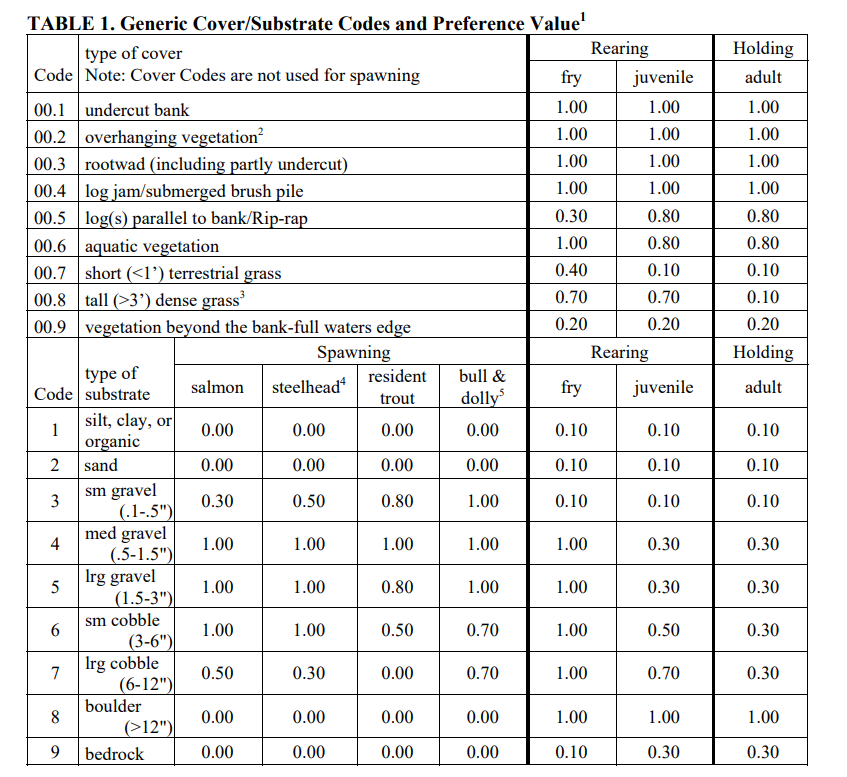
Recommended spawning substrate preference for Coho Salmon used in Washington PHABSIM/IFIM instream flow studies. Values are the WDFW–Ecology 'Recommended Preference' for dominant substrate class (rescaled 0–1 to 0–100), not the calculated (observed) preference ranges from the 30 redds. Fine dominant substrates (silt, sand) and boulder/bedrock score 0; medium gravel to small cobble are optimal. In the source, full composite codes (ab.c) weight dominant and subdominant classes (RP = c·Pa + (1−c)·Pb) and score 0 where fines exceed 20% because of smothering of incubating eggs; only the dominant-class values are represented here, as a step function.
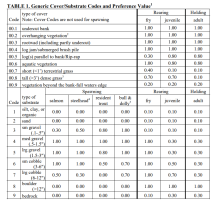
Stressor-response relationship data sourced from: TABLE 9. Coho Salmon (O. kisutch) Spawning Substrate Preference Data, Dewatto River and Fletcher Canyon Creek (2 studies, 30 redds) - Recommended Preference column (p. 36); same values as generic salmon spawning preferences in Table 1.
Dominant substrate class WDFW Table 1 codes:
1 silt/clay/organic;
2 sand;
3 small gravel 2.5–13 mm;
4 medium gravel 13–38 mm;
5 large gravel 38–76 mm;
6 small cobble 76–152 mm;
7 large cobble 152–305 mm;
8 boulder >305 mm;
9 bedrock
Stressor-response relationship data sourced from: TABLE 9. Coho Salmon (O. kisutch) Spawning Substrate Preference Data, Dewatto River and Fletcher Canyon Creek (2 studies, 30 redds) - Recommended Preference column (p. 36); same values as generic salmon spawning preferences in Table 1.
Dominant substrate class WDFW Table 1 codes:
1 silt/clay/organic;
2 sand;
3 small gravel 2.5–13 mm;
4 medium gravel 13–38 mm;
5 large gravel 38–76 mm;
6 small cobble 76–152 mm;
7 large cobble 152–305 mm;
8 boulder >305 mm;
9 bedrock
Function Derivation
Expert-adjusted recommended preferences informed by observed frequency-of-use (redd) data relative to availability.
Transferability of Function
Generic WDFW salmon spawning values; consult WDFW/Ecology before applying to local conditions.
Source of stressor Data
Redd microhabitat measurements (2 studies, 30 redds) compared with available habitat, following WDFW–Ecology instream flow study guidelines.
Function Type
step
Stressor Scale
linear
References Cited
Washington Department of Fish and Wildlife & Washington Department of Ecology. (2008). Instream flow study guidelines: Technical and habitat suitability issues including fish preference curves (Publication No. 04-11-007; updated April 5, 2004; error correction update February 12, 2008). Washington Department of Fish and Wildlife.
Citation Link
Images
Stressor Response csv data
WDFW 2004 HSI Coho Spawning Substrate.csv
(190 bytes)
| Raw Stressor Values | Scaled Response Values 0 to 100 | SD | low.limit | up.limit |
|---|---|---|---|---|
| 1 | 0 | 0 | 0 | 100 |
| 2 | 0 | 0 | 0 | 100 |
| 3 | 30 | 0 | 0 | 100 |
| 4 | 100 | 0 | 0 | 100 |
| 5 | 100 | 0 | 0 | 100 |
| 6 | 100 | 0 | 0 | 100 |
| 7 | 50 | 0 | 0 | 100 |
| 8 | 0 | 0 | 0 | 100 |
| 9 | 0 | 0 | 0 | 100 |
Stressor Response Chart
Mean Response
±1 Standard Deviation
Upper/Lower Limits