
August Mean Dissolved Oxygen and Nooksack Dace
jrosenfeld
View all records in the stressor response library
Species Common Name
Nooksack Dace
Latin Name (Genus species)
Rhinichthys cataractae sp. cataractae
Stressor Name
August Mean Dissolved Oxygen
Specific Stressor Metric
Average Disolved Oxygen for the month of August (ideally integrated using continous data, or the most representative data available).
Stressor Units
mg/L (= ppm)
Vital Rate (Process)
Growth
Geography
Lower Fraser Valley (British Columbia), Washington State (US)
Detailed SR Function Description
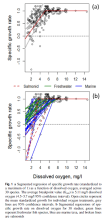
The general effects of DO on system capacity was inferred based on a meta-analysis examining the effect of Dissolved Oxygen (DO) concentration on specific growth rate of fish, which evaluated data from 38 studies on 30 freshwater and marine species (Rosenfeld and Lee 2022). The shape of the curve and threshold value (5.1 mg/L) is based on segmented regression of specific growth rate as a function of dissolved oxygen averaged across 30 species. The inference implicit in using growth as the response variable is that threshold effects of low DO on individual growth will be similar to population-level effects. Although the average segmented regression across all species is highly significant and the threshold or 5.1 mg/L is consistent with previous analyses and regulatory guidelines for water quality, it should be noted that there remains great inter-specific variation around the mean response. Some species are relatively insensitive to hypoxia, particularly warmwater species, and others (particularly coolwater species and salmonids) showing higher sensitivity (see Fig. 1 below from Rosenfeld and Lee 2022).
However, in terms of general application, the stressor-response function from Rosenfeld and Lee (2022) is based on lab growth assays where DO levels were fixed at constant values that did not vary over time. While this is a necessary feature of controlled lab experiments, the assumption of homogenous DO concentrations does not translate well to do stressor metrics collected from natural streams, which vary with time often on a daily time scale. In order to integrate the effects of time-varying DO over the summer growing season from May-August, we applied the "homogenous/instantaneous" DO stressor-response function from Rosenfeld and Lee 2022 (described elsewhere in this SR Library documentation as "Dissolved Oxygen and Nooksack Dace") to hourly DO measurements over May-August to derive a SR function where the stressor (X-axis) is mean Aug. dissolved oxygen, which is a much more easily obtained metric (in principle) than a continuous trace of DO over the summer growing season.
To achieve this, system capacity was estimated based on the modelled reduction in specific growth rate integrated over a continuous DO trace (see attached supplementary Excel file) at 33 sites measured for 3-5 days each month and inferred to be representative of the May-Aug. growing season, using data from lower Fraser Valley streams from the M.Sc. thesis of Samantha Ramirez (2024). Continuous monthly traces (hourly time series) of DO were used to integrate growth reduction over time using the homogenous/instantaneous growth reduction function based on homogenous DO from laboratory experiments from Rosenfeld and Lee (2022). Modelled integrated growth reduction across the 4 months (May-Aug.) for all 33 sites was then regressed against mean August DO data from all sites to generate the growth reduction SR function, with average Aug. DO as the stressor metric. The SR function is very similar to the homogenous/instantaneous DO SR function, but it has a notably higher intercept because the DO in early summer (e.g., May or June) may be high enough to support growth even when the DO in August is 0 mg/l.
NOTE: the comment below applies to the homogenous/instantaneous DO SR function from Rosenfeld and Lee (2022), but it is relevant to this SR function as well since it is based on the homogenous SR function.
We initially assumed that Nooksack dace would be relatively sensitive to low oxygen, as they are a riffle-dwelling species that occupy turbulent and well-oxygenated habitat. Consequently, our initial inference was to assign then the same sensitivity to reduced oxygen as salmonids, which have a relatively steeper decline in growth with reduced DO than the average for all species (Rosenfeld and Lee 2022, see Fig. 1b below). However, during sampling for fish in Aug. 2024 we made an observation which suggests that they are not as sensitive as salmonids. During a fish salvage in Pepin Creek, we placed 2 Nooksack dace in a 4l bucket along with one juvenile coho and 3 juvenile cutthroat trout (young-of-the-year). It was a warm day, and we inadvertently forgot about the bucket which was placed on the stream bank. When we checked up on it after an hour, the three yoy trout had asphyxiated, but the coho and the 2 dace were fine, and showed no sign of harm when held in the creek in a flow-through bin before release. This indicates that Nooksack dace are likely more tolerant of hypoxia than trout, despite being adapted to fast-water habitat, and we therefore used the average growth reduction vs. dissolved oxygen regression in Rosenfeld and Lee (2022; see their Fig. 1a below) as the stressor-response function for dissolved oxygen.
However, in terms of general application, the stressor-response function from Rosenfeld and Lee (2022) is based on lab growth assays where DO levels were fixed at constant values that did not vary over time. While this is a necessary feature of controlled lab experiments, the assumption of homogenous DO concentrations does not translate well to do stressor metrics collected from natural streams, which vary with time often on a daily time scale. In order to integrate the effects of time-varying DO over the summer growing season from May-August, we applied the "homogenous/instantaneous" DO stressor-response function from Rosenfeld and Lee 2022 (described elsewhere in this SR Library documentation as "Dissolved Oxygen and Nooksack Dace") to hourly DO measurements over May-August to derive a SR function where the stressor (X-axis) is mean Aug. dissolved oxygen, which is a much more easily obtained metric (in principle) than a continuous trace of DO over the summer growing season.
To achieve this, system capacity was estimated based on the modelled reduction in specific growth rate integrated over a continuous DO trace (see attached supplementary Excel file) at 33 sites measured for 3-5 days each month and inferred to be representative of the May-Aug. growing season, using data from lower Fraser Valley streams from the M.Sc. thesis of Samantha Ramirez (2024). Continuous monthly traces (hourly time series) of DO were used to integrate growth reduction over time using the homogenous/instantaneous growth reduction function based on homogenous DO from laboratory experiments from Rosenfeld and Lee (2022). Modelled integrated growth reduction across the 4 months (May-Aug.) for all 33 sites was then regressed against mean August DO data from all sites to generate the growth reduction SR function, with average Aug. DO as the stressor metric. The SR function is very similar to the homogenous/instantaneous DO SR function, but it has a notably higher intercept because the DO in early summer (e.g., May or June) may be high enough to support growth even when the DO in August is 0 mg/l.
NOTE: the comment below applies to the homogenous/instantaneous DO SR function from Rosenfeld and Lee (2022), but it is relevant to this SR function as well since it is based on the homogenous SR function.
We initially assumed that Nooksack dace would be relatively sensitive to low oxygen, as they are a riffle-dwelling species that occupy turbulent and well-oxygenated habitat. Consequently, our initial inference was to assign then the same sensitivity to reduced oxygen as salmonids, which have a relatively steeper decline in growth with reduced DO than the average for all species (Rosenfeld and Lee 2022, see Fig. 1b below). However, during sampling for fish in Aug. 2024 we made an observation which suggests that they are not as sensitive as salmonids. During a fish salvage in Pepin Creek, we placed 2 Nooksack dace in a 4l bucket along with one juvenile coho and 3 juvenile cutthroat trout (young-of-the-year). It was a warm day, and we inadvertently forgot about the bucket which was placed on the stream bank. When we checked up on it after an hour, the three yoy trout had asphyxiated, but the coho and the 2 dace were fine, and showed no sign of harm when held in the creek in a flow-through bin before release. This indicates that Nooksack dace are likely more tolerant of hypoxia than trout, despite being adapted to fast-water habitat, and we therefore used the average growth reduction vs. dissolved oxygen regression in Rosenfeld and Lee (2022; see their Fig. 1a below) as the stressor-response function for dissolved oxygen.
Function Derivation
Based on data from other species; Empirical data (experimental manipulation); Published
Transferability of Function
As local adaptations are likely minimal among different Nooksack Dace populations, we would not expect much variation in true tolerance among populations. This function should therefore be broadly applicable to all populations of the species, with the caveat that it is based on generic data from other species.
Source of stressor Data
DO data is available for several reaches in Bertrand, Pepin, Fishtrap Creeks, and the Salmon River, collected as part of reconnaissance surveys to assess fish distribution, monitoring associated with habitat restoration, and mark–recapture population assessments that took place between 2003 and 2018. A predictive model to estimate DO as a function of temperature, flow, and associated covariates will need to be generated to create the dissolved oxygen stressor dataset, in particular mean August dissolved oxygen. This STRESSOR ESTIMATION FUNCTION has been generated using data from Ramirez et al. (2024, M.Sc. thesis UBC), and is available in this SR Function Library by searching for "August Mean Dissolved Oxygen Stressor Estimation Function".
Function Type
continuous
Stressor Scale
linear
References Cited
Rosenfeld, J.S., and Lee, R. 2022. Thresholds for Reduction in Fish Growth and Consumption Due to Hypoxia: Implications for Water Quality Guidelines to Protect Aquatic Life. Environmental Management https://doi.org/10.1007/s00267-022-01678-9
Usoof, A.M. and Rosenfeld, J.S. 2024. Relationship between system capacity and Dissolved Oxygen concentration for Nooksack Dace.
Ramirez, Samantha. 2024. MODELLING THE IMPACT OF HUMAN DEVELOPMENT AND WATER QUALITY ON HYPOXIA. UBC Masters thesis, UBC Institute for the Oceans and Fisheries.
Usoof, A.M. and Rosenfeld, J.S. 2024. Relationship between system capacity and Dissolved Oxygen concentration for Nooksack Dace.
Ramirez, Samantha. 2024. MODELLING THE IMPACT OF HUMAN DEVELOPMENT AND WATER QUALITY ON HYPOXIA. UBC Masters thesis, UBC Institute for the Oceans and Fisheries.
File Upload
Images

Stressor Response csv data
Data_ND_Aug._meanDO_SysCapacity_0.csv
(296 bytes)
| Aug. Mean DO (mg/L) | Mean System Capacity (%) | SD | low.limit | up.limit |
|---|---|---|---|---|
| 0 | 25.7 | 3.2 | 0 | 100 |
| 1.3 | 44.4 | 2.3 | 0 | 100 |
| 1.7 | 50.2 | 2.2 | 0 | 100 |
| 3.2 | 71.7 | 2.8 | 0 | 100 |
| 4.3 | 87.5 | 3.8 | 0 | 100 |
| 4.8 | 94.7 | 4.4 | 0 | 100 |
| 5.15 | 100 | 3.3 | 0 | 100 |
| 5.6 | 100 | 1.9 | 0 | 100 |
| 8 | 100 | 1.9 | 0 | 100 |
| 10 | 100 | 1.9 | 0 | 100 |
| 12 | 100 | 1.9 | 0 | 100 |
| 14 | 100 | 1.9 | 0 | 100 |
Stressor Response Chart
Mean Response
±1 Standard Deviation
Upper/Lower Limits