
Lusardi et al., 2020: Temperature and juv Coho Survival
mbayly
View all records in the stressor response library
Species Common Name
Coho Salmon
Latin Name (Genus species)
Oncorhynchus kisutch
Stressor Name
Temperature
Specific Stressor Metric
MWMT
Stressor Units
°C
Vital Rate (Process)
Survivorship
Geography
Shasta River basin, California
Detailed SR Function Description
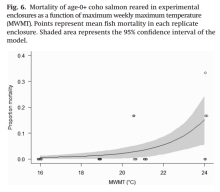
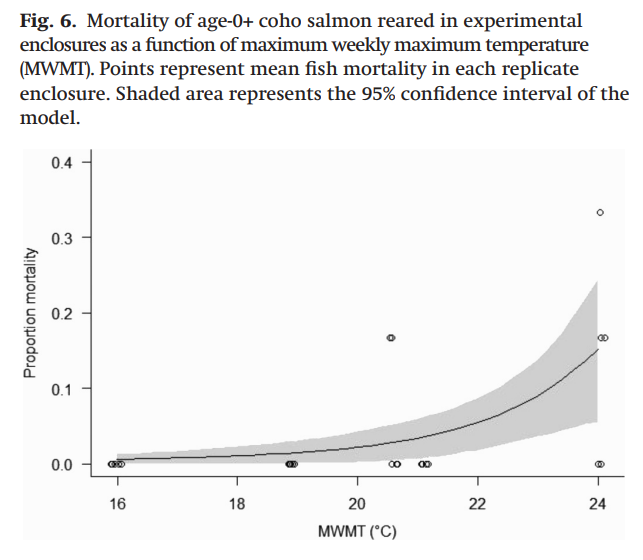
Lusardi et al. (2020) found that Coho mortality increases as the MWMT rises.
• Low Mortality: 0% observed at MWMT of 16.0–18.9°C.
• Elevated Mortality: ~13% observed at MWMT of 24.0°C.
Simple Modeling Approach: Develop a logistic function where mortality probability (P mort) increases as the 7-day moving average of maximum temperatures exceeds ~20°C.
• Low Mortality: 0% observed at MWMT of 16.0–18.9°C.
• Elevated Mortality: ~13% observed at MWMT of 24.0°C.
Simple Modeling Approach: Develop a logistic function where mortality probability (P mort) increases as the 7-day moving average of maximum temperatures exceeds ~20°C.
Function Derivation
Enclosure experiment
Transferability of Function
Potentially generalizable with review.
Source of stressor Data
To reach the conclusions regarding mortality and Maximum Weekly Maximum Temperature (MWMT), Lusardi et al. (2020) conducted a 63-day in situ enclosure experiment during the summer low-flow period (July 9–September 9, 2013) in the Shasta River basin, California.
The nature of their experiment involved the following key components:
1. Natural Thermal Gradient Selection The researchers established five study reaches along a 10-km segment of the river to exploit a natural thermal gradient created by large-volume cold-water spring inputs.
2. Experimental Enclosures They constructed 25 mesh enclosures (mesocosms) directly in the streambed (5 per reach).
3. Monitoring and Analysis Over the 63-day period, the researchers continuously logged water temperatures to calculate the MWMT for each reach. They monitored the enclosures every two days to document mortalities.
The study concluded that while food availability was the primary driver of growth (mitigating negative effects on mass gain even at high temperatures), mortality was reliably driven by the thermal stress represented by MWMT.
The nature of their experiment involved the following key components:
1. Natural Thermal Gradient Selection The researchers established five study reaches along a 10-km segment of the river to exploit a natural thermal gradient created by large-volume cold-water spring inputs.
2. Experimental Enclosures They constructed 25 mesh enclosures (mesocosms) directly in the streambed (5 per reach).
3. Monitoring and Analysis Over the 63-day period, the researchers continuously logged water temperatures to calculate the MWMT for each reach. They monitored the enclosures every two days to document mortalities.
The study concluded that while food availability was the primary driver of growth (mitigating negative effects on mass gain even at high temperatures), mortality was reliably driven by the thermal stress represented by MWMT.
Function Type
continuous
Stressor Scale
linear
References Cited
Lusardi, R. A., Hammock, B. G., Jeffres, C. A., Dahlgren, R. A., & Kiernan, J. D. (2020). Oversummer growth and survival of juvenile coho salmon (Oncorhynchus kisutch) across a natural gradient of stream water temperature and prey availability: an in situ enclosure experiment. Canadian Journal of Fisheries and Aquatic Sciences, 77(2), 413-424.
Citation Link
Images
Stressor Response csv data
usardi2020_1.csv
(156 bytes)
| Raw Stressor Values | Scaled Response Values 0 to 100 | SD | low.limit | up.limit |
|---|---|---|---|---|
| 16 | 100 | 0 | 0 | 100 |
| 18.8 | 100 | 2 | 0 | 100 |
| 18.9 | 100 | 8 | 0 | 100 |
| 24 | 87 | 8 | 0 | 100 |
| 26 | 0 | 0 | 0 | 100 |
Stressor Response Chart
Mean Response
±1 Standard Deviation
Upper/Lower Limits