
Mean Annual Discharge and Atlantic Salmon
mbakken
View all records in the stressor response library
Species Common Name
Atlantic Salmon
Latin Name (Genus species)
Salmo salar
Stressor Name
Flow
Specific Stressor Metric
Mean Annual Discharge (MAD)
Stressor Units
%
Vital Rate (Process)
Density change (%)
Life Stage
Season
Summer
Geography
Catamaran Brook, NB, Canada
Detailed SR Function Description
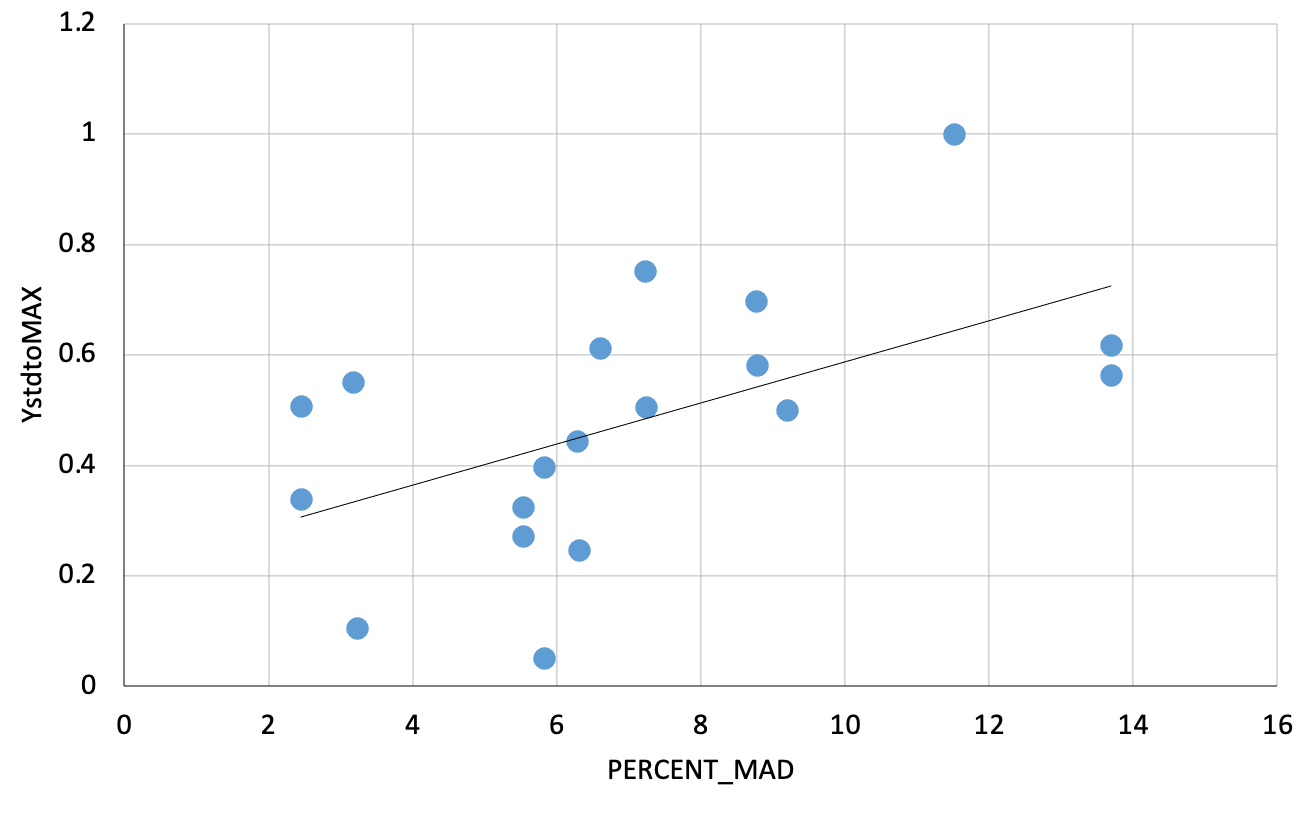
Final curve was derived from a linear regression.
System capacity was derived from 0+ age class densities. Fish abundance was estimated during annual electrofishing surveys in the summer and autumn using a multiple-sweep depletion method (Zippin, 1958). The original data points represented the composite densities pooled over all electrofished study sites within both the Lower and Gorge reaches (8 sites in total).
To normalize and rescale each ecological response, each value was scaled by the maximum ecological response observed in the study such that mean habitat capacity percentage (normalized response) = response / maximum ecological response observed.
Note that mean density in Cataman brook as estimated by digitizing densities from Fig. 2 pg. 512 of Imre et al. 2005.
Implicit pathway of effect: fish passage and survival
System capacity was derived from 0+ age class densities. Fish abundance was estimated during annual electrofishing surveys in the summer and autumn using a multiple-sweep depletion method (Zippin, 1958). The original data points represented the composite densities pooled over all electrofished study sites within both the Lower and Gorge reaches (8 sites in total).
To normalize and rescale each ecological response, each value was scaled by the maximum ecological response observed in the study such that mean habitat capacity percentage (normalized response) = response / maximum ecological response observed.
Note that mean density in Cataman brook as estimated by digitizing densities from Fig. 2 pg. 512 of Imre et al. 2005.
Implicit pathway of effect: fish passage and survival
Function Derivation
Observational data. Final curve was derived from linear regression.
Transferability of Function
Appropriate for summer stream flow impacts on 0+ age class densities of Atlantic Salmon. General transferability to other salmon stocks in unclear, but likely appropriate for other autumn-spawning salmonids (i.e., regions with similar hydrology to the Catamaran Brook).
The relationship may be unreliable if extrapolated to a flow range outside the original data (see the Average Salmonid flow-ecology SR function entry based on Rosenfeld and Enright (2025) for a more generalizable function across a wider range of flows).
The relationship may be unreliable if extrapolated to a flow range outside the original data (see the Average Salmonid flow-ecology SR function entry based on Rosenfeld and Enright (2025) for a more generalizable function across a wider range of flows).
Source of stressor Data
The winter streamflow data (discharge) for Catamaran Brook was collected using a streamflow gauging station located in the mid-basin. See methods of Cunjack et al. 2013 for details.
Data was then standardized by dividing absolute flow by MAD to achieve %MAD values (see Rosenfeld & Enright 2024). Such standardization allows for comparison of flow metrics across a wide range of stream sizes (see Rosenfeld et al. 2017).
Data was then standardized by dividing absolute flow by MAD to achieve %MAD values (see Rosenfeld & Enright 2024). Such standardization allows for comparison of flow metrics across a wide range of stream sizes (see Rosenfeld et al. 2017).
Function Type
continuous
Stressor Scale
linear
References Cited
Cunjak, R.A., Linnansaari, T., and Caissie, D. 2013. The complex interaction of ecology and
hydrology in a small catchment: a salmon's perspective. Hydrol. Process. 27: 741-749.
hydrology in a small catchment: a salmon's perspective. Hydrol. Process. 27: 741-749.
File Upload
Images
Stressor Response csv data
Data_Atlantic_Flow_Catamaran_0_0.csv
(650 bytes)
| PERCENT_MAD | Mean System Capacity (%) | SD | low.limit | up.limit |
|---|---|---|---|---|
| 2.451846154 | 30.6353862 | 0 | 0 | 100 |
| 2.452307692 | 30.6371077 | 0 | 0 | 100 |
| 3.18 | 33.3514 | 0 | 0 | 100 |
| 3.230923077 | 33.5413431 | 0 | 0 | 100 |
| 5.535692308 | 42.1381323 | 0 | 0 | 100 |
| 5.535846154 | 42.1387062 | 0 | 0 | 100 |
| 5.828461538 | 43.2301615 | 0 | 0 | 100 |
| 5.828615385 | 43.2307354 | 0 | 0 | 100 |
| 6.286153846 | 44.9373538 | 0 | 0 | 100 |
| 6.309076923 | 45.0228569 | 0 | 0 | 100 |
| 6.598461538 | 46.1022615 | 0 | 0 | 100 |
| 7.223692308 | 48.4343723 | 0 | 0 | 100 |
| 7.251846154 | 48.5393862 | 0 | 0 | 100 |
| 8.766923077 | 54.1906231 | 0 | 0 | 100 |
| 8.790769231 | 54.2795692 | 0 | 0 | 100 |
| 9.205384615 | 55.8260846 | 0 | 0 | 100 |
| 11.51876923 | 64.4550092 | 0 | 0 | 100 |
| 13.68876923 | 72.5491092 | 0 | 0 | 100 |
| 13.69 | 72.5537 | 0 | 0 | 100 |
Stressor Response Chart
Mean Response
±1 Standard Deviation
Upper/Lower Limits